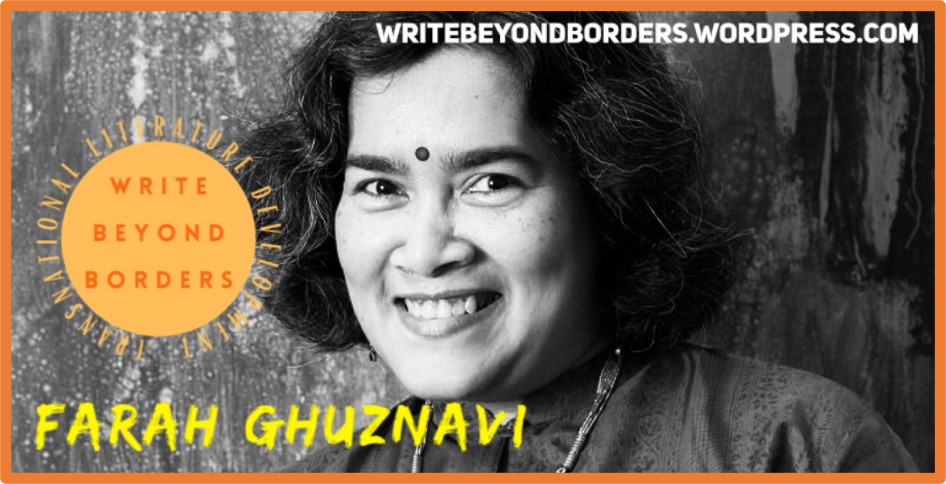
Masterclass with Farah Ghuznavi on Inspiration
By Aisha Hamid
Farah Ghuznavi, author of the short story collection Fragments of Riversong, is a development practitioner and a short story maestro. Brimming with wisdom, Farah appeared as a friend, gently nudging us through our many doubts and fears by sharing her lived experience as a self-taught writer. For Farah, her first short story, ‘A Small Sacrifice’, based on the incident of a Bangladeshi child labourer beaten to death by her employers, came to her fully formed when rage trumped her sense of inadequacy and conviction that she could not write well.
Inspiration is everywhere, Farah explains. ‘It is all a matter of keeping my eyes open’, writes Annie Dillard in Pilgrim at Tinker Creek. Inspiration is a matter of seeing, noticing, training our senses to find, and recognize images and stories in the everyday. As writers, it is our job to capture inspiration in a butterfly net.
Inspiration is an elusive thing, one that appears briefly like a gift and disappears when we are not looking, one that lies hidden in our subconscious, quietly finding its way into our writing. The sources of inspiration can be vastly varied and occasionally weird – from memory to current or past life experiences, to imagination and dreams, to sometimes an eye allergy forcing you to pay attention to your body, demanding a personal essay on self-love to be written. In each individual writing process, Farah adds, writers may take inspiration from all three: memory – what they see and remember, life experiences – what they feel or felt at that moment, and imagination – where it takes them in their mind.
For many of us who get our inspiration from those closest to us, the question of how much we can borrow from their lives remains. For that, Farah quotes Anne Lamott from Bird by Bird: Instructions on Writing and Life, ‘You own everything that happened to you. Tell your stories’, and, ‘If people wanted you to write warmly about them, they should have behaved better’. When drawing from experiences rooted in reality, Farah adds, it is worth tweaking the characters and events so they are not recognizable.
One of the ways to capture inspiration is to ask the ‘What if?’ question. For her story, ‘Judgement Day’, awarded in the Commonwealth Short Story Competition 2010, Farah asked herself, What if people began to use AI in the sex industry? This inspired her to write about a husband who brings home a humanoid robot to help his wife with childcare, only the bot nanny turns out to be for something else. Another way to capture inspiration is to ask yourself why things are a certain way and work from that to how they were and can be different.
Finally, releasing inspiration back into the wild requires you to leave the door open for critique from your beta readers, readers you trust and who are familiar with your work, and for letting the story be what it wants to be. Save your fragments of inspiration in a jar. You may end up using some of them in a work-in-progress at a later stage in life, Farah advises.
 Write Beyond Borders