

Masterclass with Abir Mukherjee
By Megha Nayar
Rather uncannily for a conversation among writers, the most talked-about aspect of Team WBB’s conversation with author-mentor Abir Mukherjee was the drawings that accompanied his masterclass!
Before he began expounding on the importance of setting in fiction, Abir put forth a disclaimer: the hand-drawn illustrations that accompanied his talk were mere scribbles meant to assist his presentation, and we were not to judge them on aesthetic appeal. By the end of the session though, we were unanimous in the verdict that Abir had been punishingly modest about his artistry, and that his “scribbles” were, in fact, the most endearing element of his discussion!
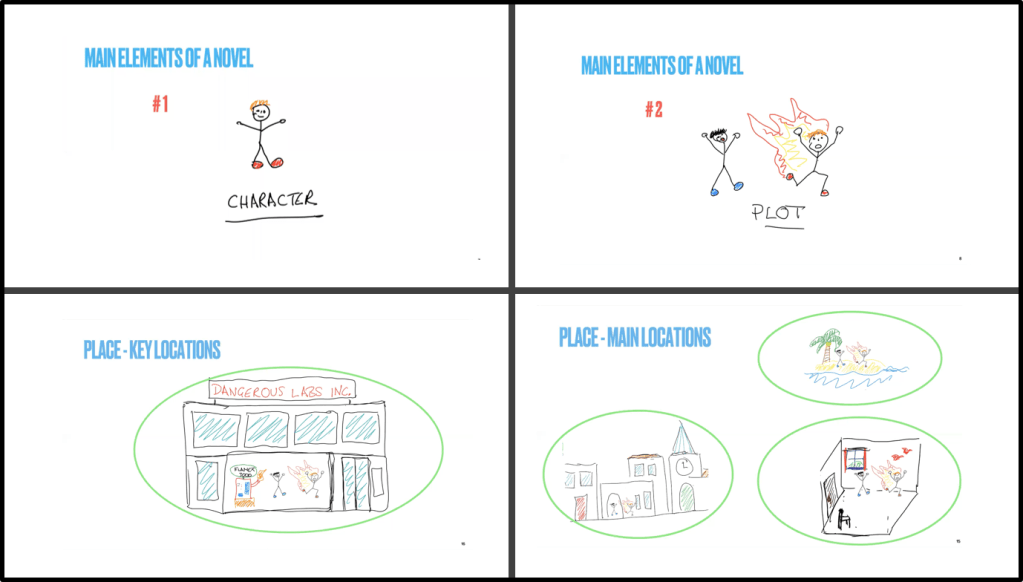
Abir announced at the outset that though setting is sometimes seen as “an ugly sister to the prima donnas of plot and character” and is often dismissed as an afterthought, it is, in principle, the bedrock that a story sits on. The setting of a story is the ecosystem within which its actors operate, and therefore, writers bear the immense responsibility of endowing their characters with the right stage for each scene. Setting is more than just background or cardboard scenery; it is the very fabric of fiction writing. It is the sea that your characters swim in. It is not just behind your characters, it is also in front of them and around them. Setting interacts with plot and characters to create the bubble that the reader inhabits while reading the story. And that is why it is imperative to get it right. A story playing out in an incorrect setting is like a play being enacted on a bare stage. Conversely, when the setting is correct, not only does it add nuance and dimensions to the plot, it also becomes a character in its own right.
Having thus established that stories are born at the intersection of plot, setting and characters, Abir went on to unpack the four core elements of setting, i.e. place, time, context and mood. Aided by examples from his own WIP novel, he explained how to identify the primary and secondary spaces within which the characters go about their lives, and how to build the broader landscape within which those spaces are located. He reminded us that the purpose of setting is not simply to offer geographical details but to provoke a specific emotional response from the reader. Setting is, as he pointed out, not just about informing your audience of the physical locations of your actors but also exposing the readers to the sentiments and sensations involved – be it the smells and sounds of an industrial town, the colours of the sky outside a window, or the flavours of the food being cooked inside a restaurant.
For us (the mentees of WBB), the biggest takeaway from this discussion with Abir was that setting is a million more things than the mere whereabouts of the people in the tale – it is also about situating them within the context of work, family, climate, interests, political beliefs, personal values, and every other variable that goes into building characters. This also warrants remembering, therefore, that the behaviour of the characters in any story must be congruous with the setting(s) that they have emerged from, and that their voices and choices must accurately reflect the circumstances they have been placed in.
Team WBB is grateful to Abir Mukherjee for this illuminating session. We are wiser for the wisdom he shared with us, and we will certainly pay closer attention to the relationship of setting with plot and characters in everything we write hereafter.
 Write Beyond Borders