
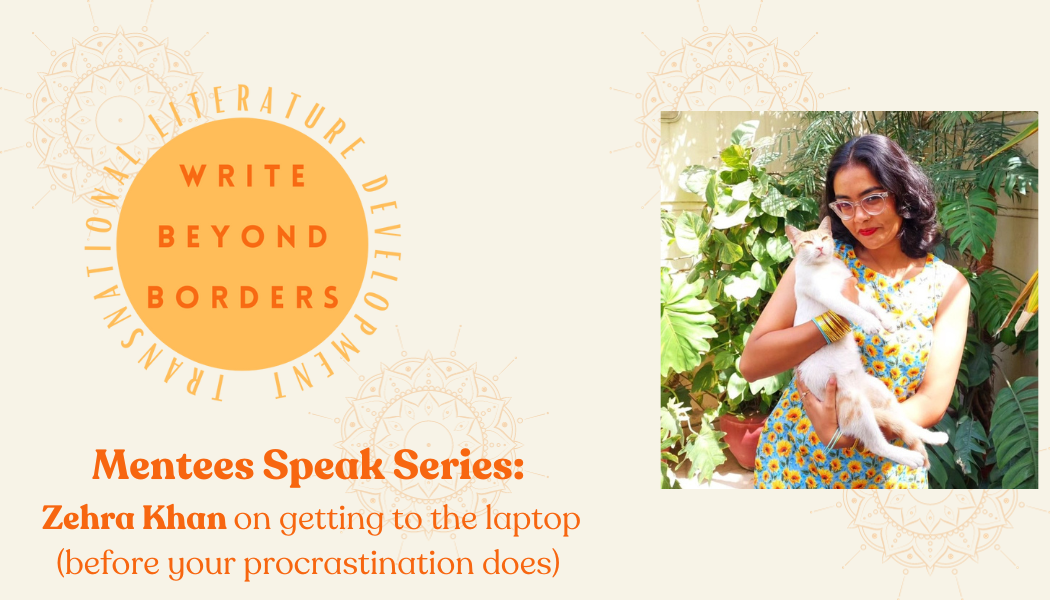
Getting to the Laptop before your Procrastination Does
Zehra Khan
Today is liquid sand; it runs freely and escapes through the soft betweens of fingers. Tomorrow is a solid house with a mirror for a main gate. This sentence is the linguistic representation of the nonsense my mind tells itself when my heart urges it to write. My heart is a far wiser creature than my mind, which is just intelligent in a standardised examination way. Even at twenty-two years, it knows that life is achingly finite and despite all of its joys and woes, life will be missed when it’s gone. So each day I can’t bring myself to write, I do not cross off my calendar. I do not consider it a lived day.
About two years ago, I attended a week-long fiction-writing residential workshop in Lahore. At the beginning of the first session, my mentor went around the table to ask each one of the eight of us what we expected to be our greatest win from the workshop. It took my tormented self no time to say, “I want to learn how to get myself to write in the first place.” In hindsight, I must have sounded so arrogant to ask that particular question when everyone was asking questions about craft and publishing, as if I already knew everything that was to be known about the latter (when, in fact, I knew nothing).
Today, as I am two years wiser, I want to write something that I owe to my younger self and to every single person younger than me who’s got a plot in their mind, voices of people they’ve never met before in their head and maps of places they know don’t exist except within them, but can’t seem to get to a pen or a laptop fast enough before their will falters.

Before I mount atop a high horse, I will preface this by saying that unlike craft or publishing, this aspect of writing is reliant on the inner workings of one’s mind and since each person is different, the ways in which they can push their mind into action is unique. For the record, I am a person who works optimally with a routine, schedule and deadlines; what you would call a Type A person (and believe me, I say this quite begrudgingly), so take my advice situated within that context.
- I’ll begin with the vaguest advice. Think about your writing. When you come up with a story in your mind, spend about a week simply thinking about it. Allow yourself to fall in love with the plot, its settings and its characters because when you do, you will want to write to know more about them.
- Access literature. A writer is foremost a reader and this is not simply a theoretical declaration. Reading literature that you admire and that aligns with the kind of work you want to produce will ignite a kinship between you and the world of writers. Similarly, watching writers talk about their craft or hearing another writer-friend do so can push you off your couch and towards your laptop. Always remember, the love of writing never leaves you; its flame just needs a whiff of air from time to time.
- Plan as much of your story as you can. I understand that the longer a work of literature is, the more joy there is to be extracted from where the text will take you. But writing a backbone or skeleton of the work with a summary of the plot as you understand it, character sketches and a loose timeline will make the work of writing less staccato and tiresome, fighting the fearful procrastination monster in all of us.

- Set aside a time and a place dedicated solely to your writing. It could be a desk, the side of your bed that you don’t sleep in or a place entirely outside your home which is easily accessible on a routine basis. Set up an alarm on your phone for every single day at a time you are aware will most likely be free; mine has a horrifically loud sound which resounds at 9:30 p.m. every day with a flashing message on my phone screen, “Do you want to write this book or not?”
- Design a writing ritual. Basically, you’re Pavlov’s-dog-ing yourself. Light a candle or play a particular instrumental on repeat or spray a fresh scent where you write but essentially repeat an action before writing each time to wire your brain in a way where the action always leads to writing.
- Set a very realistic target. I understand that it is devastating to not be able to write with the ease of breathing but believe me, no one writes for 2000 words in two hours every single day for a year. Unfortunately, I’m speaking from personal experience. Write a hundred words but write them most days of the week. When you set a realistic target, you won’t be able to make an excuse for not accomplishing it. Plus, we all deserve small wins.
- Forgive yourself. Whether you’re a student or a professional, we are all stuck in the endless rhythm of life. But it is important to understand that it is our life itself which bestows upon us the gift of writing. As writers, we do our most important work at the periphery, at the cost of sustaining our lives. We deserve the sympathy we give to our characters. So, on the days you are too tired, too sleep-deprived, too burnt out, take a break. Or your body will make you take one anyway.
Even as I write this at one in the morning, my hope is that my voice has reached out to you in a way which connects us through this grand struggle of the writer’s life. Between starting and finishing a story, there is a field; meet yourself there.
 Write Beyond Borders