
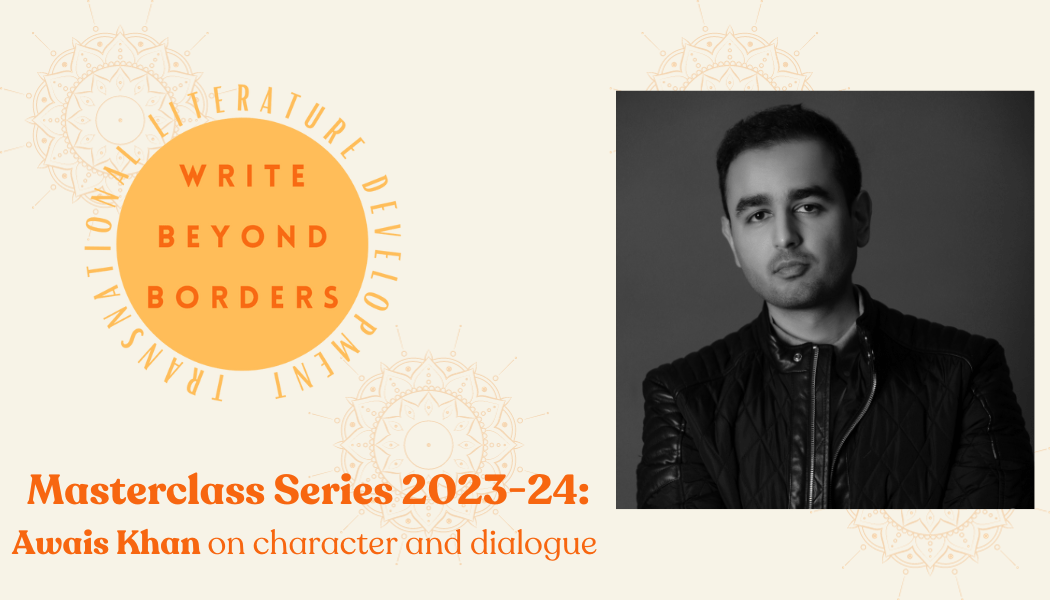
A masterclass with Awais Khan
by Nayab Malik
Awais Khan’s Masterclass on character and dialogue felt like a tea party with dear friends on a sunny afternoon in winter. His various references to beloved characters from familiar stories made the class feel like it were being led by old friends, all eager to teach by example. All these fictional familiars, from Du Maurier’s Rebecca to Fitzgerald’s Jay Gatsby, lent their voices to the class, adding important insights into the characterization and dialogue writing process.
It all began with Titanic and Twilight. Jack and Rose, Bella and Edward. Seemingly innocuous names, but as Awais put it, instantly recognizable by almost anyone in the English-speaking world. So, what is it about these characters that has made them memorable? Is it the Rose-left-Jack-to-drown debate or the fact that Bella was willing to suffer for immortality and hence, for everlasting love?
The answer? According to Awais, it’s all of those reasons and more. He explained that characters need to be believable and not necessarily realistic. The Twilight folk are vampires, Albus Dumbledore is a wand-wielding wizard, and Flora from The Bees by Laline Paull is a worker bee. They may not be real, but they are believable.
These characters have motivations that readers can understand and relate to. Characters form the center of any strong story. Readers should be able to identify with them as they experience conflict, tension and climax. Awais referenced Anna Karenina and how her decisions shaped the plot of the novel. Her actions were striking enough that she leapt off of the page – and on to the train track – with energy, making herself memorable to readers that might otherwise forget the story.
In order to be memorable, a character has to be three dimensional. Awais asserted that any character must have a full range of emotions and responses. They shouldn’t be stereotyped or robotic. Rather, they should have individual personalities that unfold as the story is told. A three-dimensional character is described through a creative lens, whether that’s a nickname or a unique trait. It could also be a compelling origin story.
Origin stories don’t need to justify a character’s actions; they just have to add an extra layer of believability. Awais spoke about Voldemort. This is an innately evil character but if J.K. Rowling had left him without a backstory, he would have also been two dimensional. Instead, readers got to experience his childhood and adolescence, making him an intensely believable villain.
Above all, well-written characters have an all-encompassing driving force in their lives. Awais explained that all characters should have motivations, whether high minded or basic. Scarlett O’Hara wanted Rhett Butler to want her, as Jay Gatsby did Daisy. These characters are still remembered for very much wanting the things, or people, that they did. So much so, that their motivations led their respective plots in those directions.
Awais discussed not emphasizing characters’ physical appearances or personalities, unless there is something unusual or extreme about them. He explained that these features are inevitably revealed through their words and actions: “Don’t tell the reader that Sue is mean. Show her being ungenerous.”
This brought the class to one of the oft-discussed rules in fiction: show, don’t tell. While Awais highlighted that there are many instances where telling is necessary, he explained, dialogue is the best vehicle to show. Well-knit dialogue reveals a lot about characters and is a powerful way to progress a story. It pushes a plot, sets pace and adds excitement. Charged and impactful dialogue between characters will hype up readers and bring a sense of movement to the narrative.
Good dialogue adds depth to characters; readers learn about their varied ways of speaking, their frames of mind, and their relationships with others. In order to craft powerful dialogue, writers should understand their characters. The way characters communicate will invariably be influenced by their social class, upbringing, their past and their present.
An effective way to write emotionally charged dialogue is to imagine yourself in your character’s shoes. Awais talked about the importance of frame of mind. He gave the example of a character whose house is burning down. An effective writer would imagine themselves in that scenario and tap into the emotions that rise up before writing dialogue for that particular scene.
Awais cautioned against trying to write realistic dialogue. As with characters, he said dialogue has to be believable and not realistic. A realistic Astrid from White Oleander would probably be rendered speechless by the traumatizing events of her life. A fictional Astrid, on the other hand, is able to deliver caustic one-liners with apparent ease, making her a believable, if not realistic, protagonist.
Astrid, like many other strong characters, also uses another form of communication: inner dialogue. Awais explained that writers can use repetition when creating inner dialogue but only with deliberation. Similarly, indirect speech is only effective when used with purpose, either to avoid giving out small bits of information or needless repetition of events or dialogue.
While repetition can be a clever way to make a point, it can annoy the reader if used with dialogue tags. The ‘he saids’ and ‘she saids’ should be kept to a minimum unless there is likely to be confusion or they’re being used deliberately. Writers must give due credit to readers. Characters should also not talk too much in one go; as Awais pointed out, people don’t usually sit and ramble on without gestures or actions.
Characters reveal themselves best through a mixture of words and actions. They do it more effectively when there is a layer of subtext to both these elements. Awais mentioned the poignant scene from The Great Gatsby, where Daisy starts to sob at what seems to be a pile of well-made clothing. Readers know she’s crying over Jay and what she’s lost, even though the characters only ever talk about shirts.
What is talked about is important and so is how it’s talked about. Awais ended the class with some useful tips on formatting dialogue:
- Create a new paragraph when a new character starts to speak.
- If a character speaks and performs and actions, then speaks again, it remains in the same paragraph
- Use an ‘em dash’ to indicate when a character is interrupted.
- When a dialogue extends beyond a paragraph, use quotation marks at the beginning of the following paragraph.
- Inner dialogue doesn’t usually require quotation marks.
- Always read your dialogue out loud to yourself to get a sense of whether it works.
He also said that rules can always be broken, provided one has a reason for doing so that is in service of their story.
And so, the Masterclass came to an end and took with it my comfortable friends from fiction and real life. Onwards we write, until next week.
 Write Beyond Borders