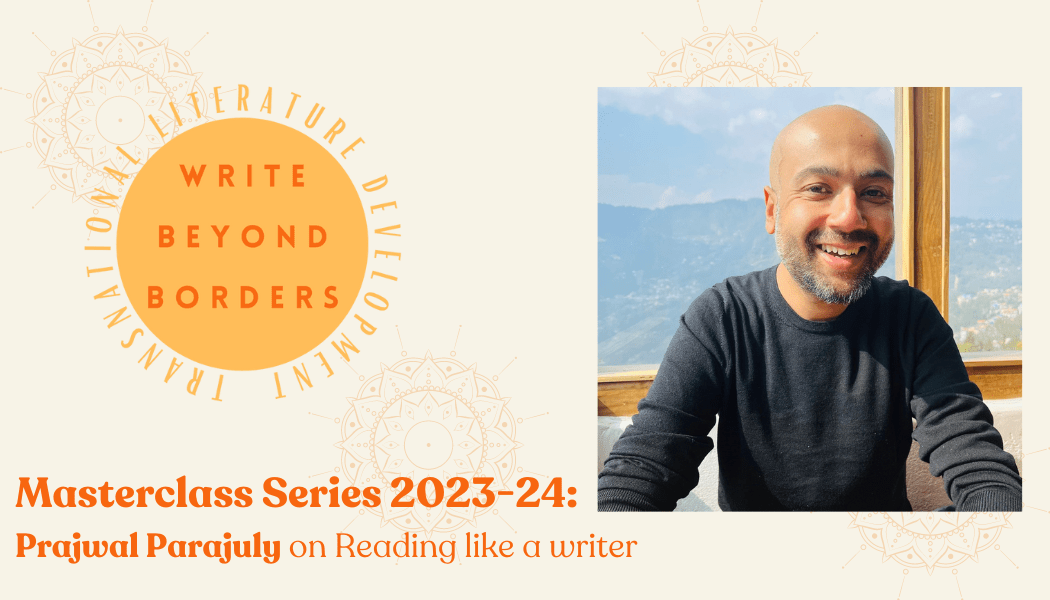
A masterclass with Prajwal Parajuly
by Madri Kalugala
Long before we became, or even aspired to become, writers, all of us were almost certainly at some point readers. Whether or not we managed to retain that reading practice – that voracious appetite for reading that we had as children, that capacity to devour entire books in one sitting, that deep-seated love for the smell of books, libraries and yellowed pages – as writers, I think we can all attest to the fact that we were, and are, shaped by the stories that we read. Prajwal Parajuly’s masterclass for Write Beyond Borders, proved to be a unique and thought-provoking session that took a different take on this very theme of writers and their practice of reading. It covered an extremely interesting and vital aspect of writing that is not spoken of enough, and – as pointed out by Prajwal – not taught to writers early on enough in their writing careers: the importance of learning the art of reading like a writer.
Prajwal began the Masterclass by giving us a brief introduction as to why he chose this particular topic for his session. Drawing from examples of his own writing life, he explained that when he set out to write his highly successful first collection of short stories, The Ghurka’s Daughter, he actually had very little idea how to write: having not taken a formal creative writing class, everything he knew about writing thus far was what had been taught by his high-school English teacher. Hence, he elaborated how, when setting out to write a short story, he was daunted by all the technicalities: how exactly does one balance exposition with speech, narrative with dialogue? How could one effectively squeeze in four different points of view into less than 3000 words? As an enthusiastic 23-year-old, he recalls how he often wrote pages of exposition, was confounded by choices in punctuation and dialogue tags, and felt immense pressure trying to bring a short story to effective resolution.
Looking for inspiration and advice, Prajwal described how he turned to reading books on writing— avidly scouring books on dialogue, technique, economy, writing characters and setting, etc., for tips on how to write well. But nothing, Prajwal told us, helped as much as Francine Prose’s book Reading Like a Writer.
Quoting an excerpt from Prose’s excellent book, which proved to be life-altering on his personal journey as a writer, Prajwal went on to elaborate to us what it meant to learn to read a book like a writer, rather than as a mere reader. Prose’s definition describes this as: “Reading like a writer entails reading for pleasure first, but [more importantly], analytically, conscious of style, of how sentences were formed, and information was being conveyed, how the writer was structuring a plot, creating characters, employing detail and dialogue”.
Writer Amy Wilson also highlights this as the key difference in “reading like a writer vs. a consumer of fiction”. Prajwal’s explanation of this concept hit home for me as I related to how similar it felt to the reading of a literary work as a ‘student’ of literature- as opposed to a reader (and enjoyer) of books. Interestingly, however, Prajwal also noted how he had long been doing this, albeit subconsciously, before even coming across the concept of reading like a writer. He elaborated on this with a personal story where, during a bout of slowness in his own writing, he had turned to reading Vikram Seth’s A Suitable Boy. Choosing the book as an escape from his own writing, Prajwal recalled how the novel turned out to be an immersive read – where he began reading slowly, pausing often, making annotations and markings in his copy, and carefully analyzing the writer’s techniques on the page.
Learning to read Vikram Seth like a writer, therefore, had been a turning point in 23-year-old Prajwal’s own writing life. He explained to us in detail how, by analyzing the writing, the style, dialogues, and the particular details ranging from paragraph indentations to the minimal use of dialogue tags in the novel, he began to truly see the magic of Seth’s writing emerge on the page. When practiced and applied to reading all books in general, Prajwal elucidated, this approach of mindful, analytical reading can indubitably serve to make one a more conscious writer.
Wishing that he himself had been taught these at a younger age, Prajwal then passed down these precious nuggets of advice to us during the enlightening masterclass session:
- Read books that have been declared excellent: Apply the practice of reading like a writer to books that have received critical acclaim, particularly in the genre that you are writing or are interested in– and read as many as you can.
- Re-read: The more you re-read a text, the more you become acquainted with nuances and tools employed by the writer in their creation of the work. It allows you to better observe the micro vs. macro, and examine writer’s choices and techniques – making you better at reading like a writer.
- Ask questions: As you read, reflect carefully and ask yourself questions such as, “Why am I invested?”, “What is the author hoping to achieve?” and “How does he/she set the scene?”, which constantly draw your focus back to analyzing the author’s techniques and choices.
- Take notes: Contrary to popular opinion, do not consider it sacrilege to write down notes in a book as you read it; it is actually a mark of highest respect! A book which is chock-full of annotations and scribbled notes is proof that you have taken it seriously.
- Read widely in other genres; sometimes even terrible books: Reading in genres that you don’t yourself write can teach you how to write specific scenes or sections, while reading terrible books can be highly instructional in how not to write!
- And last but most importantly: Do not allow reading like a writer to suck the joy out of reading!
With this last point, Prajwal hit a point that resonated with me on a personal level. Having found that during my undergraduate years, the academic study of literature actually put me off books, and both reading and writing, altogether. I found Prajwal’s anecdotes on how he adored and re-read Arundhati Roy’s The God of Small Things with pleasure – up until it was made mandatory reading for his creative writing Master’s – extremely relatable. However, Prajwal explained that the trick is to mix and match being a casual reader who reads for pleasure, together with reading like a writer – in other words, finding the fine balance between reading for entertainment vs. education. With the session spurring interesting discussions among the WBB writers and leaving us with much food for thought, this particular masterclass left an indelible impression on me!
 Write Beyond Borders