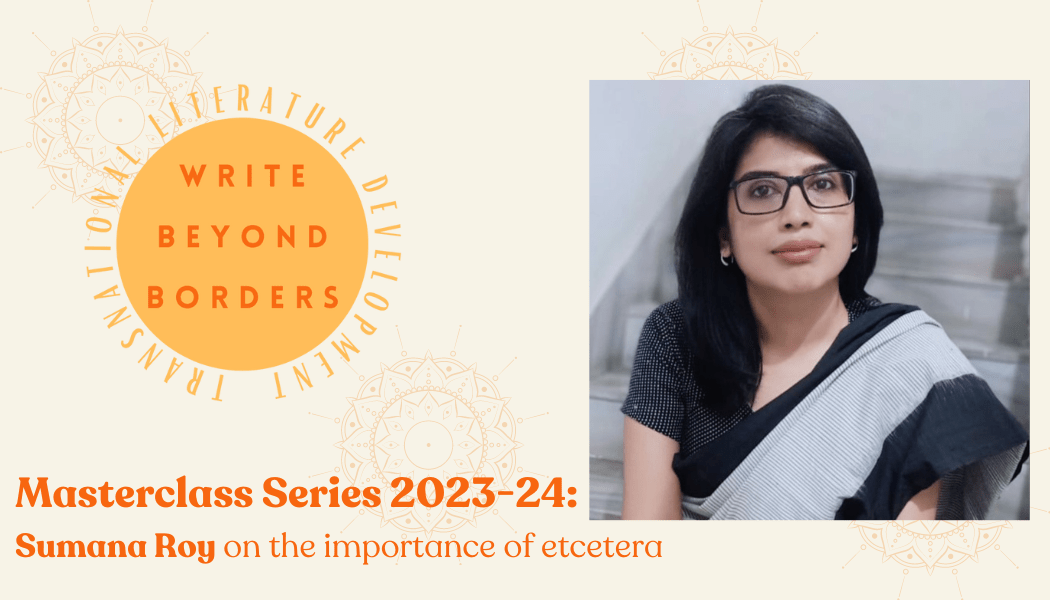
A masterclass with Sumana Roy
by Shahriar Shaams
As writers we often find ourselves wondering where to be specific and where to let “etcetera” / “etc.” do our work. Sumana Roy’s class revolved around this aspect of craft. From the decisions we must make in our translations to the complexities of selecting and rejecting what gets space in our stories and poems and what doesn’t, the etcetera plays a perennially important role.
Sumana Roy, who teaches in India, is an author of numerous books of prose and poetry. Her latest book, Provincials: Postcards from the Peripheries (Yale University Press, 2024), explores the art and the artist labeled “regional” and “of the peripheries”, mixing literary history with incidents of small-town life. With similar attention to language and a trawl through a vast section of art and life, Sumana Roy’s class has been a memorable one.
Roy reminds us that our exercise with etcetera begins before we go into the text proper. When, as writers, we write our bios to send along with our pieces to magazines and journals, we choose which prior publications to highlight and conceal the rest under “…among other places”.
Sumana Roy contrasts the English “etcetera” with the Bengali “ittadi (ইত্যাদি)”, used for similar reasons. While etc. is broadly defined as “the rest” or “unspecified additional items” (to use Webster’s language), the Bengali ittadi is a joining of two ideas. The iti meaning “the end” and adi, meaning “the beginning”. One begins to then see how through matters of language we can treat the etcetera as either “leftovers” or as “everything” from the beginning to the end, as well.
Even something simple as “many” can contain multitudes, as Roy shares a personal anecdote of writing “I have many toys” in an exam in a hurry as a child. The “many” here then must bear the responsibility of representing all the diverse toys she must have possessed.
Roy asks, “What is the moment when a writer or even a painter or a filmmaker decide that ‘etcetera’ will do that work?”
In the Wordsworth poem “I Wandered Lonely as a Cloud”, which we read in the class, Roy suggests we notice how Wordsworth used words such as “a host”, “continuous”, “never ending line” and “ten thousand” as “etceterization” in the poem. These words are integral to the poem, as Roy maintains, though they are etceterized.
“Extras, etcetera, and ittadi might help us understand the decision making process of selection and rejection,” says Roy, “that is the spine of any creative process, no matter which medium or genre.”
Etcetera has the power “to render those clubbed together as anonymous.” Roy stresses how it is not a casual aspect of writing, but has political dimensions, using as example the captions of photos printed in newspapers, where only the famous and significant are mentioned specifically while the rest are etc., more akin to background.
The class veers back to the reading of poems, with Roy choosing three poems centered on Iranian cafes in Bombay. The first of this, “Irani Restaurant Instructions” by Nissim Ezekiel is a found poem, where the poet makes use of instructions such as “Do not spit” and “pay promptly” to construct the entirety of the poem, withholding any “judgment”. Roy considers the etceterization here to be the poet’s judgment itself.
.In the subsequent poem by Arun Kolatkar (“Irani Restaurant Bombay”), we see how he concentrates on the etcetera of an Irani cafe: the portrait of the shah on the wall or the fly on “a loafer’s wrist”, whereas in the third poem, “Breakfast Time at Kala Ghoda,” also by Kolatkar, we notice how he lists out the menu-items from neighboring Irani cafes at breakfast time. It is in contrast to the Ezekiel poem, Roy points out, as the latter focused on the signs outside the restaurant’s main product, the food.
Roy brings up the pleats of a sari – the etcetera of the garment that gives it its beauty. Her perceptive lecture ends with us reading two brief texts. A poem by A.K. Mehrotra (“January”) and a short-story by Lydia Davis (“The Outing”), both of which bring up the etcetera in their work through their very titles.
Sumana Roy’s words profoundly resonated with the class, and gave us much to think of. The power and privilege of words make it all the more important that we pay attention to what we choose to highlight and what we couch under “etcetera”. Roy’s thought-provoking masterclass was a testament to that.
 Write Beyond Borders
Good post, I subscribed. Have a happy day☘️
LikeLike