
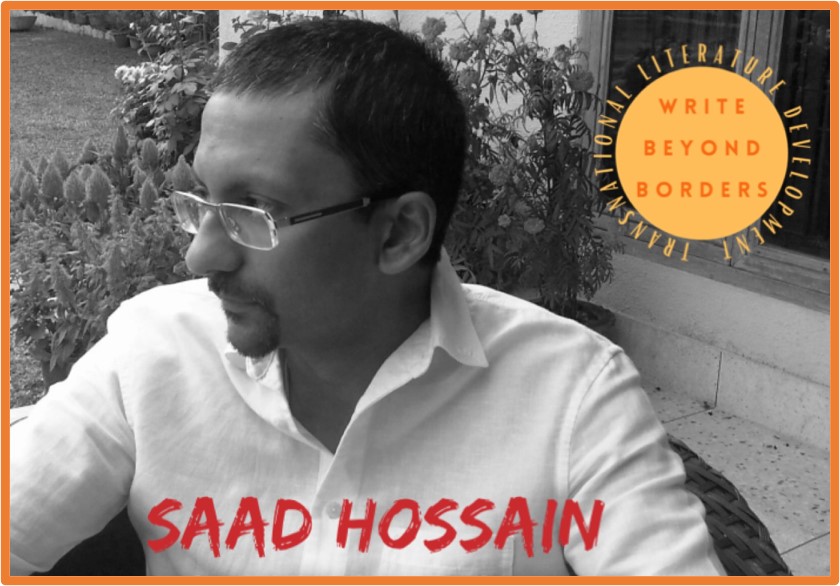
World-building with Saad Z Hossain
by Tanvi Srivastava
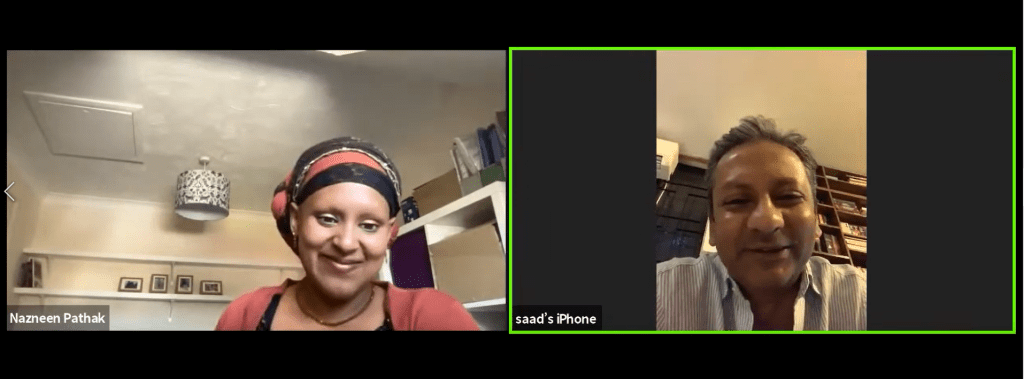
A monsoon evening in Dhaka, a bookshelf stretching to the ceiling. Saad joins the WBB mentees via Zoom to describe his writing journey and to share some tips of the trade.
Journey as a writer
Saad laughs when asked to describe his journey as a ‘serious writer’. Sometimes, he admits, he still doesn’t feel like a serious writer. He started getting published five or six years ago, and since then the journey has become easier. “You no longer have to worry about marketing and so on,” he says. “When people commission you for stories, you realise you have become a writer.”
About World-building
World-building is probably the biggest tool available to science fiction and fantasy writers, but is required in all kinds of fiction.
Saad himself writes urban fantasy, which is any fiction set in the real world that has an element of fantasy, for example, the Harry Potter series. The real world exists and then in smaller pockets, we find this magical world. This makes world-building narrower — you need to figure out the physics of magic, and then maintain the internal logic of this world through your stories.
Murakami is another example, who uses fantastical elements to create a mood and atmosphere, but not really drive the plot. Salman Rushdie is another example.
Historical fiction is more complicated since you need to respect facts, unlike fantasy. But the joy here is recreating a world out of dry facts, for example, Colleen McCullough’s Masters of Rome series. As you get closer to reality, your tools shrink, so you can’t make up things as you go along.
In general fiction, if the setting is unknown to readers, you have to do world-building too. You need to expand on the history and the culture of the space. By building a world before you write, you bring cohesion to the story and it adds to the character and the plot.
Technical aspects of world-building (including tips)
The biggest danger of world-building is to go overboard. Writers will have the urge to describe, for example, every room, when in reality the reader can only take so much before it gets boring. You need to build your world but not include everything in the story.
Tip 1: Any big piece of world-building you include in your story should be used in the plot, like Chekhov’s gun. If it’s there, it should have some relevance to the plot in the future. Use it.
Tip 2: Use a base template, especially fantasy. For example, the Harry Potter series uses stories set in British boarding schools (such as those by Enid Blyton) as a template. This gives the reader the comfort of the familiar. Similarly, Tolkien uses elves and giants as a base, and then introduces more fantastical elements to it.
Tip 3: Pretend to know stuff. Go deep rather than broad. Instead of describing every aspect of a fully-armed modern-day soldier, describe his gun or helmet in a lot of detail. The reader will assume you have the same knowledge about the rest of his gear. Without going into detail, the reader will assume he is wearing equally high-end gear. This helps you save space.
Tip 4: You should only describe things that are pertinent to the story. Once you’re done writing, go back and cut the unnecessary out, even though it may be a solid part of the world. You want your stories to seem circular and connected.
Tip 5: Use world-building to get ‘unstuck’. If your plot is going nowhere, build on the world, change the setting. Reuse a setting you’ve already built, rather than introduce something on page 600. World-building helps you write.
The masterclass with Saad was an exceptional experience for the WBB mentees. Aside from the tips that we received, Saad’s passion for writing left us all inspired. His warmth and support for new writers is sure to leave an indelible mark on all of us.
 Write Beyond Borders
I especially loved tip #3 about going deep on detail for a single aspect. I’ve never seen it described so concisely. Thanks for sharing Saad’s valuable perspective. Great interview.
LikeLike